
Online Database of Chemicals from Around the World
| Nutrition BioTech USA Inc. | USA | |||
|---|---|---|---|---|
 | www.naturalbestbio.com | |||
 | +1 (909) 745-1357 | |||
 | sales@naturalbestbio.com | |||
| Chemical manufacturer since 2024 | ||||
| chemBlink Standard supplier since 2026 | ||||
| Classification | Biochemical >> Inhibitor >> Transmembrane transporters >> Calcium channel inhibitor |
|---|---|
| Name | Magnesium Ascorbate |
| Synonyms | (+)-Magnesium L-ascorbate; magnesium bis((2R)-2-[(1S)-1,2-dihydroxyethyl]-3-hydroxy-5-oxo-2H-furan-4-olate) |
| Molecular Structure | 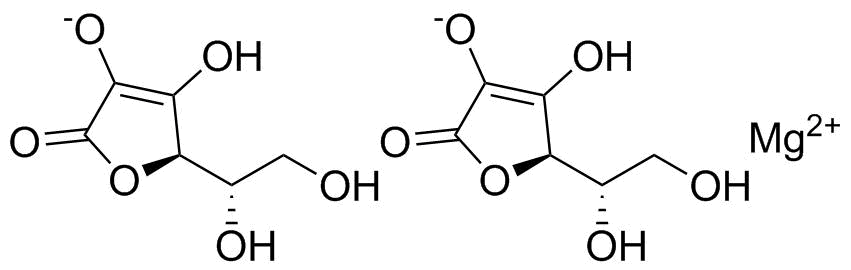 |
| Molecular Formula | C12H14MgO12 |
| Molecular Weight | 374.54 |
| CAS Registry Number | 15431-40-0 |
| EC Number | 239-442-6 |
| SMILES | C([C@@H]([C@@H]1C(=C(C(=O)O1)[O-])O)O)O.C([C@@H]([C@@H]1C(=C(C(=O)O1)[O-])O)O)O.[Mg+2] |
| Hazard Symbols |  GHS07 Warning Details |
|---|---|
| Risk Statements | H302-H315-H319 Details |
| Safety Statements | P501-P270-P264-P280-P302+P352-P337+P313-P305+P351+P338-P362+P364-P332+P313-P301+P312+P330 Details |
| SDS | Available |
 chemBlink Chemical Story
|
Magnesium ascorbate is a mineral salt of vitamin C. Its organic partner is ascorbate, the conjugate base of L-ascorbic acid. The structure of ascorbic acid does not contain a free carboxylic acid group. It contains a lactone ring and an enediol unit, in which two hydroxyl groups attach to the two carbons of a double bond. Loss of a proton from that region gives an ascorbate ion whose charge can be distributed among more than one atom. For the usual di-L-ascorbate description, two organic anions balance one magnesium ion. Ascorbate can participate in redox reactions by donating electrons. Its oxidized chemistry includes dehydroascorbic acid, a species distinct from the magnesium salt. Changing the counterion changes the starting material and can affect properties such as the pH of a solution, without creating a new vitamin or eliminating the underlying redox chemistry. Solution conditions affect the distribution of forms and the behavior of the dissolved ingredient. A claim about stability in one formulation thus needs evidence specific to that formulation. There is a second issue that a chemical name can hide: water in the solid. The chemBlink entry for this registry number is titled magnesium ascorbate hydrate. The FDA substance registry associates the same number with magnesium ascorbate. These descriptions can serve different record-keeping purposes, so the use of the broad name here should not be taken to specify an anhydrous grade or the number of water molecules in a sample. Water content should be established from a material specification if it matters for the calculation. The NIH Dietary Supplement Label Database records magnesium ascorbate as a label ingredient. Salt mass, vitamin C content and elemental magnesium are three different quantities. A given mass of hydrated material also includes water that adds to neither nutrient quantity. The salt is therefore a useful example of why ingredient identity and nutrient amounts deserve separate entries in a technical description. The label record documents use in formulations; it does not show that they outperform another vitamin C source. References: 1. FDA Global Substance Registration System, magnesium ascorbate. https://precision.fda.gov/ginas/app/ui/browse-substance?search=root_codes_comments%3A%22Magnesium%20ascorbate%22 2. NIH Office of Dietary Supplements, magnesium ascorbate labels. https://dsld.od.nih.gov/ingredient/Magnesium-ascorbate 3. chemBlink, magnesium ascorbate hydrate entry, CAS 15431-40-0. https://www.chemblink.com/en/products/15431-40-0.htm |
| Market Analysis Reports |