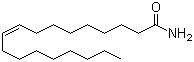
Oleamide has two scientific lives. Polymer technologists know it as a fatty amide that can help plastic surfaces slide. Biochemists identified the same structure in studies of endogenous lipids. These two contexts have very different experimental questions, but the identity of the molecule is the same: a cis double bond in an eighteen-carbon chain and a terminal primary amide.
The name relates it to oleic acid. In oleamide the acid's hydroxyl is replaced by an amino group, creating a carboxamide. The polar end can participate in hydrogen bonding, while most of the molecule is a hydrocarbon chain. The cis double bond changes the geometry of the chain relative to a fully saturated fatty amide. Oleamide is therefore not stearamide, the saturated counterpart, and is not oleic acid simply because both retain a cis double bond in the same position.
In polyethylene film, a slip additive changes a surface property. The processing goal is often to reduce the resistance encountered when two surfaces move past one another. A fatty amide dispersed in the polymer can migrate toward an interface over time. The useful effect depends on where the additive ends up, not simply on its average concentration in the film. The bulk polymer can remain the principal material while the surface behaves differently.
A test taken immediately after making a film can accordingly answer a different question from one taken after storage. Temperature and film construction can affect how an additive reaches the surface. A reduction in friction also does not guarantee every other surface property is favorable: a film that slides easily may still have to be printed, sealed, or bonded. Testing the actual structure and processing history is more informative than treating all slip agents as interchangeable.
In a quite different setting, Cravatt and colleagues used synthetic chemistry to support the structural assignment of oleamide in a trace natural sample. That work illustrates the value of comparing a candidate structure with a known synthetic counterpart. A chemical structure can be confirmed more rigorously than by assuming that any lipid with a similar mass has the same double-bond geometry or terminal group. The findings opened a biological question about endogenous fatty amides, rather than establishing an industrial material as a sleep treatment.
The cis geometry also provides a lesson in what an analytical reference needs to match. Molecules with the same atoms and the same position of unsaturation can still differ in the arrangement around that double bond. Changing the geometry affects the shape of the chain without changing its exact mass. Comparing a sample with a reference therefore requires more than checking that the masses agree. That is a useful connection between the structural work on the natural lipid and the selection of a defined fatty amide for a technical use.
The two lines of research also suggest why analytical context matters. When a compound has technical uses and is measured at trace levels, a careful experiment must distinguish a signal originating in the sample from one associated with equipment or handling. Controls that omit the biological sample help address this question. A positive identification is about both the structure detected and the origin of the signal. Oleamide is a good example of how an apparently simple fatty amide can be important to the engineering of an interface and to the interpretation of a biological measurement, without conflating the two uses.
References:
1. PubChem. Oleamide, CID 5283387. https://pubchem.ncbi.nlm.nih.gov/compound/5283387
2. Cravatt BF et al. Structure determination of endogenous oleamide. JACS (1996). https://doi.org/10.1021/ja9532345
3. Chemiversal. Oleamide technical data for polymer processing. https://2017erp.com/app/webroot/download/product_techds_pdf/301-02-0_4.pdf
|







 GHS07 Warning Details
 chemBlink Chemical Story