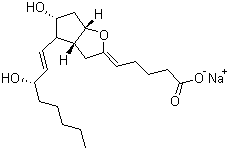
Prostacyclin sodium salt is the sodium carboxylate of epoprostenol, also called prostaglandin I2. The sodium identifies the salt, rather than a replacement of the organic framework. A salt is useful for specifying the material in a formulation, but salt formation does not eliminate the chemical reactivity of the rest of the molecule. The organic portion remains an unusually short-lived signal under physiological conditions.
Its history began with a striking difference between tissues. In 1976 Moncada and colleagues reported that material from arteries could convert prostaglandin endoperoxides into an unstable product that inhibited platelet aggregation. The product was initially called PGX and later identified as prostacyclin. The finding provided a way to think about the vessel wall as an active participant in controlling platelets rather than simply as a surface through which blood passes. An unstable local messenger could oppose other signals that favor aggregation.
Instability is part of the chemical story, not an incidental defect. The cyclic enol ether in prostacyclin is susceptible to hydrolysis, producing 6-keto-prostaglandin F1α. The product is not identical to the original signal. In a biological experiment, detection of a hydrolysis product can therefore provide information about prior formation of prostacyclin without measuring the original molecule directly. In a pharmaceutical formulation, conditions that influence degradation are also relevant to how much intact material remains.
Epoprostenol formulations are used for pulmonary arterial hypertension under their prescribing information. The vasodilator effect and the short persistence of the compound matter to the development of the medicine. These features should not be translated into independent directions for handling or administering a particular preparation. Different formulations have their own validated specifications. The scientific connection is that a transient endogenous signal, discovered through a platelet experiment, could also inform drug development. It remained necessary to account for the lifetime of the signal rather than treating instability as something that disappeared once a sodium salt was available.
References:
1. FDA GSRS. Epoprostenol sodium substance identity. https://precision.fda.gov/uniisearch/srs/unii/4K04IQ1OF4
2. Moncada S et al. Arterial enzyme and the unstable platelet aggregation inhibitor PGX. Nature (1976). https://doi.org/10.1038/263663a0
3. DailyMed. Epoprostenol prescribing information. https://dailymed.nlm.nih.gov/dailymed/drugInfo.cfm?setid=2a163b77-9e01-4516-b19c-f5a12ce48560
|







 GHS07 Warning Details
 chemBlink Chemical Story