
Online Database of Chemicals from Around the World
| Taizhou Crene Biotechnology Co., Ltd. | China | |||
|---|---|---|---|---|
 | www.pharm-intermediates.com | |||
 | +86 (576) 8881-3233 8820-5808 +86 13396860566 | |||
 | +86 (576) 8822-9589 | |||
 | sales@pharm-intermediates.com | |||
 | QQ Chat | |||
| Chemical manufacturer since 2011 | ||||
| chemBlink Standard supplier since 2009 | ||||
| Ningbo Kilo Biotechnology Co., Ltd. | China | |||
|---|---|---|---|---|
| www.kilobio.com | |||
| +8613989352104 | |||
| terry.zhang@kilobio.com | |||
| QQ Chat | |||
 | WeChat: Wenzhou Medical University | |||
| Chemical distributor since 2023 | ||||
| chemBlink Standard supplier since 2023 | ||||
| Classification | API >> Hormone and endocrine-regulating drugs >> Prostaglandins |
|---|---|
| Name | Gemeprost |
| Synonyms | Carprost; Cergem; Cervagem; Cervageme; ONO 802; Preglandin; SC 37681 |
| Molecular Structure | 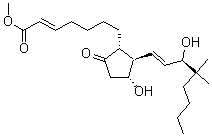 |
| Molecular Formula | C23H38O5 |
| Molecular Weight | 394.54 |
| CAS Registry Number | 64318-79-2 |
| EC Number | 264-775-9 |
| SMILES | CCCCC(C)(C)[C@@H](/C=C/[C@H]1[C@@H](CC(=O)[C@@H]1CCCC/C=C/C(=O)OC)O)O |
| Solubility | Practically insoluble (0.025 g/L) (25 °C), Calc.* |
|---|---|
| Density | 1.080±0.06 g/cm3 (20 °C 760 Torr), Calc.* |
| Boiling point | 510.5±50.0 °C 760 mmHg (Calc.)* |
| Flash point | 163.9±23.6 °C (Calc.)* |
| Index of refraction | 1.533 (Calc.)* |
| * | Calculated using Advanced Chemistry Development (ACD/Labs) Software. |
| Hazard Symbols |   GHS06;GHS08 Danger Details | ||||||||||||||||||||
|---|---|---|---|---|---|---|---|---|---|---|---|---|---|---|---|---|---|---|---|---|---|
| Risk Statements | H301-H312-H332-H360 Details | ||||||||||||||||||||
| Safety Statements | P203-P261-P264-P270-P271-P280-P301+P316-P302+P352-P304+P340-P317-P318-P321-P330-P362+P364-P405-P501 Details | ||||||||||||||||||||
| Hazard Classification | |||||||||||||||||||||
| |||||||||||||||||||||
 chemBlink Chemical Story
|
Gemeprost is a synthetic analogue of prostaglandin E1. It preserves several recognizable features of prostaglandin chemistry, including a substituted five-membered ring and two different side chains. Its name refers to a specific methyl ester, not to the free acid or to the family as a whole. The structure also includes an additional double bond near the ester and a dimethyl substitution in the other side chain. These features help distinguish it from naturally occurring prostaglandin E1 and from other synthetic analogues. A methyl ester differs from a carboxylic acid by a small change with potentially important consequences. The free acid can ionize under appropriate conditions, whereas the ester lacks that acidic proton. An ester can also be hydrolyzed, so a description of the administered substance and a description of species formed afterward need not be the same. These are general chemical possibilities; the structure alone does not quantify tissue exposure or establish what any other ester would do. The Australian Cervagem product information describes gemeprost as a prostaglandin analogue used in defined clinical settings involving cervical preparation and termination of pregnancy. It describes effects on uterine smooth muscle and on the cervix. The two tissues and their responses should not be collapsed into one vague notion of hormonal activity. It is also misleading to identify gemeprost as a progesterone receptor blocker merely because some clinical contexts overlap with those of other medicines. This compound illustrates how a prostaglandin framework can be retained while its terminal group and side chains are altered. Its clinical history belongs to a specified medicine, formulation, and supervised setting. Information about the molecule is not a protocol for using it, and a labeled application in one jurisdiction does not establish availability or authorization elsewhere. The most useful chemical reading is therefore to connect the exact ester identity to the documented formulation while keeping both distinct from the actions of other prostaglandin analogues. References: 1. PubChem. Gemeprost, CID 5282237. https://pubchem.ncbi.nlm.nih.gov/compound/gemeprost 2. Cervagem Australian product information. https://apps.medicines.org.au/files/swpcerva.pdf |
| Market Analysis Reports |