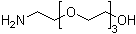
11-Amino-3,6,9-trioxaundecanol has a primary amine at one end and an alcohol at the other. Three ether oxygens lie within the chain, and the hydroxyl supplies a fourth oxygen. Its formula is C₈H₁₉NO₄. The frequently used label Amino-PEG4-alcohol counts the glycol-derived segment differently from the replacement name's explicit list of three internal oxygen positions. Neither name implies four internal ether oxygens plus an additional alcohol oxygen.
The terminal mismatch gives the reagent its synthetic character. The amine can be used in appropriately designed coupling reactions, while the alcohol remains a different functional group available for another transformation. The technical description identifies activated esters and other carbonyl-containing partners among the relevant reaction classes. A reaction with a carboxylic acid generally needs suitable activation; merely putting an acid and amine together does not establish isolation of an amide.
The alcohol is not a carboxylic acid, and the amine is not an aminooxy group. Those distinctions prevent a common error in choosing short ether-rich connectors: exchanging a terminal group can change the intended chemistry even if the central chain looks familiar. An amino-alcohol, an amino-acid-ended chain and a diamine are three different building blocks with different possibilities for subsequent assembly.
Its ether oxygens add polar sites along a flexible path. In a completed molecule, however, the attached partners also affect solubility and movement. The starting reagent's hydrophilic description cannot establish the properties of every derivative. Nor does the PEG4 shorthand identify one fixed end-to-end distance in solution.
The evidence supports a defined amino-alcohol for molecular functionalization rather than a unique discovery narrative or a demonstrated therapeutic effect. Its useful feature is that the two ends can be assigned different tasks. Preserving that difference through reaction planning and analytical confirmation is what turns a short chain into a controlled construction element, rather than assuming that all PEG-labeled reagents serve the same purpose.
References:
1. TCI. Amino-PEG4-alcohol, A3876, CAS 86770-74-3. https://www.tcichemicals.com/OF/en/p/A3876
2. Sigma-Aldrich. Amino-dPEG4-OH, QBD10249, structural identity. https://www.sigmaaldrich.com/US/en/product/aldrich/qbd10249
3. BroadPharm. Amino-PEG4-alcohol, BP-20589, functional-group applications. https://broadpharm.com/product/bp-20589
|






 GHS05;GHS07 Danger Details
 chemBlink Chemical Story