
Online Database of Chemicals from Around the World
| Nanjing Taiye Chemical Industry Co., Ltd. | China | |||
|---|---|---|---|---|
 | www.taiyechem.com | |||
 | +86 (25) 5233-7972 | |||
 | +86 (25) 5233-7971 | |||
 | market@taiyechem.com taiyechem@gmail.com | |||
| Chemical manufacturer since 2001 | ||||
| chemBlink Standard supplier since 2007 | ||||
| Simagchem Corporation | China | |||
|---|---|---|---|---|
| www.simagchem.com | |||
| +86 13806087780 | |||
| +86 (592) 268-0237 | |||
| sale@simagchem.com | |||
| Chemical manufacturer since 2002 | ||||
| chemBlink Standard supplier since 2008 | ||||
| BOC Sciences | USA | |||
|---|---|---|---|---|
| www.bocsci.com | |||
| +1 (631) 485-4226 | |||
| +1 (631) 614-7828 | |||
| info@bocsci.com | |||
| Chemical manufacturer | ||||
| chemBlink Standard supplier since 2010 | ||||
| Ereztech LLC | USA | |||
|---|---|---|---|---|
| www.ereztech.com | |||
| +1 (888) 658-1221 | |||
| sales@ereztech.com | |||
| Chemical distributor since 2010 | ||||
| chemBlink Standard supplier since 2011 | ||||
| Earlier HK Company Limited | China | |||
|---|---|---|---|---|
| www.earlierchem.com | |||
| +86 (10) 6142-6769 +86 18616907430 | |||
| +86 (10) 6142-6769 | |||
| info@earlierchem.com | |||
 | QQ Chat | |||
| Chemical manufacturer since 2011 | ||||
| chemBlink Standard supplier since 2013 | ||||
| DQ Pure | Indonesia | |||
|---|---|---|---|---|
| dqpure.com | |||
| +86 13588024337 | |||
| lu@dqpure.com | |||
 | WhatsApp:+8613588024337 | |||
| Chemical manufacturer since 2008 | ||||
| chemBlink Standard supplier since 2026 | ||||
| Xinyu Dongpeng Chemical Co., Ltd. | China | |||
|---|---|---|---|---|
| www.rubidium-cs.com | |||
| +86 (790) 686-4666 646-4661 646-4662 | |||
| +86 (790) 646-4663 | |||
| jxxydpc@163.com | |||
| Chemical manufacturer since 2000 | ||||
| ProChem, Inc. | USA | |||
|---|---|---|---|---|
| www.prochemonline.com | |||
| +1 (815) 398-1788 | |||
| +1 (815) 398-1810 | |||
| prochem3@aol.com | |||
| Chemical manufacturer since 1986 | ||||
| Strem Chemicals, Inc. | USA | |||
|---|---|---|---|---|
| www.strem.com | |||
| +1 (978) 499-1600 | |||
| +1 (978) 465-3104 | |||
| info@strem.com | |||
| Chemical manufacturer | ||||
| Materion | USA | |||
|---|---|---|---|---|
| www.materion.com | |||
| +1 (216) 486-4200 | |||
| +1 (414) 289-9805 | |||
| info@materion.com | |||
| Chemical manufacturer | ||||
| Classification | Inorganic chemical industry >> Inorganic base |
|---|---|
| Name | Rubidium hydroxide |
| Molecular Structure | 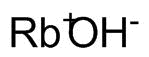 |
| Molecular Formula | RbOH |
| Molecular Weight | 102.47 |
| CAS Registry Number | 1310-82-3 |
| EC Number | 215-186-0 |
| SMILES | [OH-].[Rb+] |
| Density | 3.2 g/mL (Expl.) |
|---|---|
| Solubility | Soluble in water, alcohol (Expl.) |
| Hazard Symbols |   GHS05;GHS07 Danger Details GHS05;GHS07 Danger Details | ||||||||||||||||||||||||||||
|---|---|---|---|---|---|---|---|---|---|---|---|---|---|---|---|---|---|---|---|---|---|---|---|---|---|---|---|---|---|
| Risk Statements | H302-H312-H314-H332 Details | ||||||||||||||||||||||||||||
| Safety Statements | P260-P261-P264-P270-P271-P280-P301+P317-P301+P330+P331-P302+P352-P302+P361+P354-P304+P340-P305+P354+P338-P316-P317-P321-P330-P362+P364-P363-P405-P501 Details | ||||||||||||||||||||||||||||
| Hazard Classification | |||||||||||||||||||||||||||||
| |||||||||||||||||||||||||||||
| Transport Information | UN 2677 | ||||||||||||||||||||||||||||
| SDS | Available | ||||||||||||||||||||||||||||
 chemBlink Chemical Story
|
Rubidium hydroxide is an inorganic compound consisting of the alkali metal rubidium combined with hydroxide ions, with the chemical formula RbOH. It is a strong base and belongs to the group of alkali metal hydroxides, which also includes sodium hydroxide and potassium hydroxide. Like other compounds in this class, it dissociates completely in aqueous solution to produce rubidium ions (Rb+) and hydroxide ions (OH−), resulting in highly alkaline behavior. The compound is composed of rubidium cations and hydroxide anions arranged in an ionic lattice in the solid state. Rubidium is a highly electropositive element from Group 1 of the periodic table, and it readily forms +1 oxidation state compounds. The hydroxide ion is responsible for the strong basicity of the compound, as it readily accepts protons in aqueous environments. This leads to a high pH in solution, similar to other alkali metal hydroxides. Rubidium hydroxide is typically obtained through the reaction of rubidium metal or rubidium oxide with water. The reaction of rubidium metal with water is highly exothermic and produces rubidium hydroxide and hydrogen gas. Rubidium oxide also reacts with water to form the hydroxide in a more controlled manner. Due to the high reactivity of rubidium metal, its hydroxide is usually handled in solution or as stabilized solid forms rather than produced directly in large quantities. Historically, rubidium compounds were first studied in the mid-19th century following the discovery of rubidium by Robert Bunsen and Gustav Kirchhoff using spectroscopy. While potassium and sodium compounds were more abundant and widely used, rubidium chemistry was explored mainly for scientific purposes due to its rarity and similarity to other alkali metals. Rubidium hydroxide itself has been less commonly used industrially compared with sodium or potassium hydroxide, but it is important in specialized chemical research. In solution, rubidium hydroxide behaves as a strong base, fully dissociating into its constituent ions. It reacts readily with acids to form rubidium salts and water in neutralization reactions. It can also react with carbon dioxide from the air to form rubidium carbonate, which is a common pathway for alkali hydroxides exposed to atmospheric conditions. Rubidium hydroxide is used primarily in research applications rather than large-scale industrial processes. It has been employed in studies of alkali metal trends, solid-state chemistry, and as a reagent in specialized organic synthesis where rubidium ions may influence reaction behavior. In some cases, rubidium salts derived from the hydroxide are investigated for use in optical materials, atomic physics experiments, and specialized electronic applications. From a physical chemistry perspective, rubidium hydroxide exhibits properties consistent with other heavy alkali hydroxides, including high solubility in water and strong basicity. However, due to the larger ionic radius of rubidium compared to sodium or potassium, its lattice energy and solvation behavior differ slightly, which can influence its reactivity and physical properties. Overall, rubidium hydroxide is a strong inorganic base composed of rubidium and hydroxide ions. While it is chemically similar to other alkali metal hydroxides, its use is largely confined to laboratory and research contexts due to the limited availability and cost of rubidium. Its study contributes to a broader understanding of periodic trends and alkali metal chemistry. References 2026. Highly stable all-perovskite tandem solar cells with targeted conversion of tin–lead surfaces. Nature Photonics. DOI: 10.1038/s41566-025-01815-w 2025. Asymmetric photooxidation of glycerol to hydroxypyruvic acid over Rb–Ir catalytic pairs on poly(heptazine imides). Nature Nanotechnology. DOI: 10.1038/s41565-025-01897-1 2022. COMPARATIVE CRYSTAL CHEMISTRY, SYMMETRY FEATURES, AND STRUCTURAL COMPLEXITY OF LiOH, NaOH, RbOH, CsOH, AND TlOH HYDROXIDES. Journal of Structural Chemistry. DOI: 10.1134/s0022476622120174 |
| Market Analysis Reports |