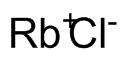
Rubidium chloride is an inorganic ionic compound with the chemical formula RbCl. It consists of rubidium cations (Rb+) and chloride anions (Cl−) arranged in a crystalline lattice. As an alkali metal halide, it is chemically similar to sodium chloride and potassium chloride, but it is less commonly encountered due to the relatively low abundance of rubidium in nature.
In the solid state, rubidium chloride adopts the same crystal structure as sodium chloride (rock salt structure). In this arrangement, each rubidium ion is surrounded octahedrally by six chloride ions, and each chloride ion is similarly coordinated by six rubidium ions. This highly symmetric structure is stabilized by strong electrostatic interactions between the oppositely charged ions.
Rubidium chloride is typically prepared by neutralizing rubidium hydroxide or rubidium carbonate with hydrochloric acid. In these acid–base reactions, rubidium hydroxide reacts directly with hydrochloric acid to form rubidium chloride and water, while rubidium carbonate produces rubidium chloride, water, and carbon dioxide gas. The resulting solution can be evaporated to yield crystalline rubidium chloride.
In aqueous solution, rubidium chloride dissociates completely into rubidium and chloride ions. Because it is derived from a strong acid (HCl) and a strong base (RbOH), the resulting solution is neutral and does not undergo significant hydrolysis. This behavior is characteristic of alkali metal halides.
Rubidium chloride has been used primarily in laboratory and research applications. It serves as a convenient source of rubidium ions in chemical experiments and is used in studies of alkali metal chemistry, crystallography, and spectroscopy. Rubidium salts, including rubidium chloride, are also used in atomic physics and quantum optics research, particularly in experiments involving laser cooling and atomic clocks.
In biomedical research, rubidium chloride has historically been studied as a potassium analog because rubidium ions can partially substitute for potassium ions in biological systems due to their similar ionic radii. This property has allowed rubidium isotopes and compounds to be used as tracers in physiological studies of ion transport and cellular uptake mechanisms.
From a physical chemistry perspective, rubidium chloride exhibits typical properties of alkali halides. It is a white crystalline solid with relatively high melting point and good solubility in water. Its lattice energy is lower than that of lighter alkali halides such as sodium chloride due to the larger ionic radius of Rb+, which results in a more expanded crystal lattice and weaker electrostatic interactions.
Historically, rubidium chloride gained scientific importance following the discovery of rubidium in 1861 through flame spectroscopy by Robert Bunsen and Gustav Kirchhoff. Subsequent studies of rubidium salts helped establish trends in the alkali metal group and contributed to the development of periodic classification in chemistry.
Overall, rubidium chloride is a simple ionic compound composed of rubidium and chloride ions arranged in a rock salt crystal lattice. It is primarily used in research applications involving alkali metal chemistry, physical measurements, and specialized studies in atomic and biological systems where rubidium can serve as a potassium analog.
References
2025. Heterologous expression and functional characterization of recombinant arenin to assess its anticancer and wound-healing potential. Bioresources and Bioprocessing.
DOI: 10.1186/s40643-025-00986-2
2025. Rubidium chloride induces ferroptosis in glioblastoma cells by disrupting glutathione metabolism and redox homeostasis. Cancer Cell International.
DOI: 10.1186/s12935-025-04085-2
2025. Engineering the optoelectronic properties of lead-free Rb2B’BiCl6 (B = K, Li) double perovskites: highly efficient blue light emission. Optical and Quantum Electronics.
DOI: 10.1007/s11082-025-08566-6
|






 GHS07 Warning Details
 chemBlink Chemical Story