
Online Database of Chemicals from Around the World
| BOC Sciences | USA | |||
|---|---|---|---|---|
 | www.bocsci.com | |||
 | +1 (631) 485-4226 | |||
 | +1 (631) 614-7828 | |||
 | info@bocsci.com | |||
| Chemical manufacturer | ||||
| chemBlink Standard supplier since 2010 | ||||
| Creative Peptides | USA | |||
|---|---|---|---|---|
| www.creative-peptides.com | |||
| +1 (631) 624-4882 | |||
| +1 (631) 614-7828 | |||
| info@creative-peptides.com | |||
| Chemical manufacturer | ||||
| chemBlink Standard supplier since 2010 | ||||
| Changzhou Jiuwu Chemical Co., Ltd. | China | |||
|---|---|---|---|---|
| www.jiuwuchem.com | |||
| +86 (519) 8512-1086 +86 13775162768 | |||
| +86 (519) 8512-5369 | |||
| info@jiuwuchem.cn | |||
 | QQ Chat | |||
| Chemical manufacturer since 2009 | ||||
| chemBlink Standard supplier since 2023 | ||||
| AnaSpec, Inc. | USA | |||
|---|---|---|---|---|
| www.anaspec.com | |||
| +1 (800) 452-5530 | |||
| +1 (510) 791-9560 | |||
| service@anaspec.com | |||
| Chemical manufacturer | ||||
| Watanabe Chemical Ind., Ltd. | Japan | |||
|---|---|---|---|---|
| www.watanabechem.co.jp | |||
| +81 (82) 231-0540 | |||
| +81 (82) 231-1451 | |||
| inquiry@watanabechem.co.jp | |||
| Chemical manufacturer | ||||
| Classification | Biochemical >> Amino acids and their derivatives >> Valine derivatives |
|---|---|
| Name | 3-[[(Acetylamino)methyl]thio]-N-[(9H-fluoren-9-ylmethoxy)carbonyl]-L-valine |
| Molecular Structure | 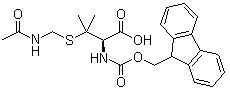 |
| Molecular Formula | C23H26N2O5S |
| Molecular Weight | 442.53 |
| Protein Sequence | X |
| CAS Registry Number | 201531-76-2 |
| EC Number | 820-397-1 |
| SMILES | CC(=O)NCSC(C)(C)[C@@H](C(=O)O)NC(=O)OCC1C2=CC=CC=C2C3=CC=CC=C13 |
| Solubility | Practically insoluble (0.012 g/L) (25 °C), Calc.* |
|---|---|
| Density | 1.281±0.06 g/cm3 (20 °C 760 Torr), Calc.* |
| Boiling point | 709.3±60.0 °C 760 mmHg (Calc.)* |
| Flash point | 382.8±32.9 °C (Calc.)* |
| Index of refraction | 1.604 (Calc.)* |
| * | Calculated using Advanced Chemistry Development (ACD/Labs) Software. |
| Hazard Symbols |  GHS07 Warning Details |
|---|---|
| Risk Statements | H302-H315-H319-H335 Details |
| Safety Statements | P261-P305+P351+P338 Details |
| SDS | Available |
 chemBlink Chemical Story
|
A peptide with four sulfur-containing side chains can form more than one disulfide pattern, even when its amino-acid sequence is fixed. Fmoc-Pen(Acm)-OH, CAS 201531-76-2, belongs to the chemistry used to manage that problem. Its full systematic name describes an acetamidomethyl-protected sulfur on a penicillamine framework, with a separate Fmoc group protecting the amino nitrogen. Penicillamine can be understood as beta,beta-dimethylcysteine. Instead of cysteine's CH2SH side chain, it has a carbon bearing sulfur and two methyl groups. The valine-based systematic name in this entry expresses the same connectivity by describing substitution at carbon 3. It does not make this an ordinary valine derivative lacking sulfur, and the compact Pen abbreviation is useful for recognizing the shared structure. Acm means acetamidomethyl. The sulfur is connected to a CH2NHCOCH3 group, which masks the free thiol. This is not the same as directly acetylating sulfur. Fmoc and Acm occupy different atoms and have different jobs: the former helps manage chain assembly, while the latter can preserve sulfur for a later transformation. Removing amino protection does not automatically remove sulfur protection. The problem becomes intuitive if four thiols are labeled A, B, C, and D. They can pair as AB/CD, AC/BD, or AD/BC. All three possibilities contain two disulfide bridges, but they connect different parts of the peptide. Simply counting oxidized sulfur atoms therefore cannot identify the intended topology. Which side chains are connected can determine the shape and behavior of the molecule. Protection can impose an order on that pairing. If one pair becomes reactive while another remains masked, the first bridge can be established before the second pair is addressed. Acm has been used in such differentiated sulfur-protection schemes, including strategies that distinguish it from trityl protection. The complete sequence must be compatible with all residues and other protecting groups; selectivity is an experimentally established property of a chosen strategy, not an unlimited promise attached to the abbreviation. A 1991 study by Albericio and colleagues examined solid-phase cyclization of disulfide-containing peptides using protected cysteine or penicillamine residues, including Acm-based sulfur protection. This provides historical context for the approach. Later work continues to exploit differentiated sulfur protection, but a study using Acm on cysteine and trityl on penicillamine should not be misreported as direct use of the present Acm-protected penicillamine reagent. The two methyl groups around penicillamine sulfur add another variable beyond protection. They alter the local steric environment relative to cysteine, so forming a bridge does not guarantee that a Pen-containing peptide behaves exactly like its Cys-containing counterpart. Protection controls when chemistry can occur; residue structure influences the environment in which the resulting bond exists. Intramolecular pairing is not the only possible outcome when sulfur becomes available. Two different peptide molecules can also connect through a disulfide, producing intermolecular species instead of the intended ring within one chain. A successful design must therefore manage both which sulfur atoms react and whether the connection occurs within the desired molecular unit. Successful analysis must therefore address both composition and connectivity. A mass consistent with two disulfides may still leave different pairing patterns unresolved. Sequence-aware structural or chemical analysis is needed when topology is important. Fmoc-Pen(Acm)-OH is interesting because it combines a defined steric variation with a temporary sulfur mask, helping turn disulfide construction from a general oxidation into a problem of programmed molecular connections. References: 1. Bachem. Fmoc-Pen(Acm)-OH, product 4016442; CAS 201531-76-2. https://shop.bachem.com/product/4016442/ 2. Albericio F et al. Cyclization of disulfide-containing peptides in solid-phase synthesis. International Journal of Peptide and Protein Research (1991). https://doi.org/10.1111/j.1399-3011.1991.tb00755.x |
| Market Analysis Reports |